
Australia’s low power prices challenge renewable investment
Australia’s wholesale electricity prices have fallen to unusually low levels by international standards, creating potential relief for consumers while raising concerns about the investment case for new renewable generation.
Analysis by Rystad Energy shows Australia’s eastern states averaged about US$50 per megawatt hour in wholesale electricity prices during the first nine months of 2026. Among the countries and markets included in the comparison, only Brazil and the United States recorded lower national average prices.
Victoria recorded an average of US$38/MWh, while Queensland was at US$45/MWh, NSW at US$53/MWh, Tasmania at US$56/MWh and South Australia at US$68/MWh. Western Australia averaged US$79/MWh.
By comparison, wholesale prices were reported at US$174/MWh in Italy, US$166/MWh in Ireland, US$145/MWh in the United Kingdom and US$134/MWh in Germany.
Batteries and mild conditions push prices lower
The lower Australian prices were attributed to a combination of mild weather, rapid deployment of large batteries, continuing coal-fired generation and record-low use of gas-fired power.
Federal Energy Minister Chris Bowen said wholesale prices were only one component of electricity bills but expected retailers to pass sustained reductions in generation costs through to customers.
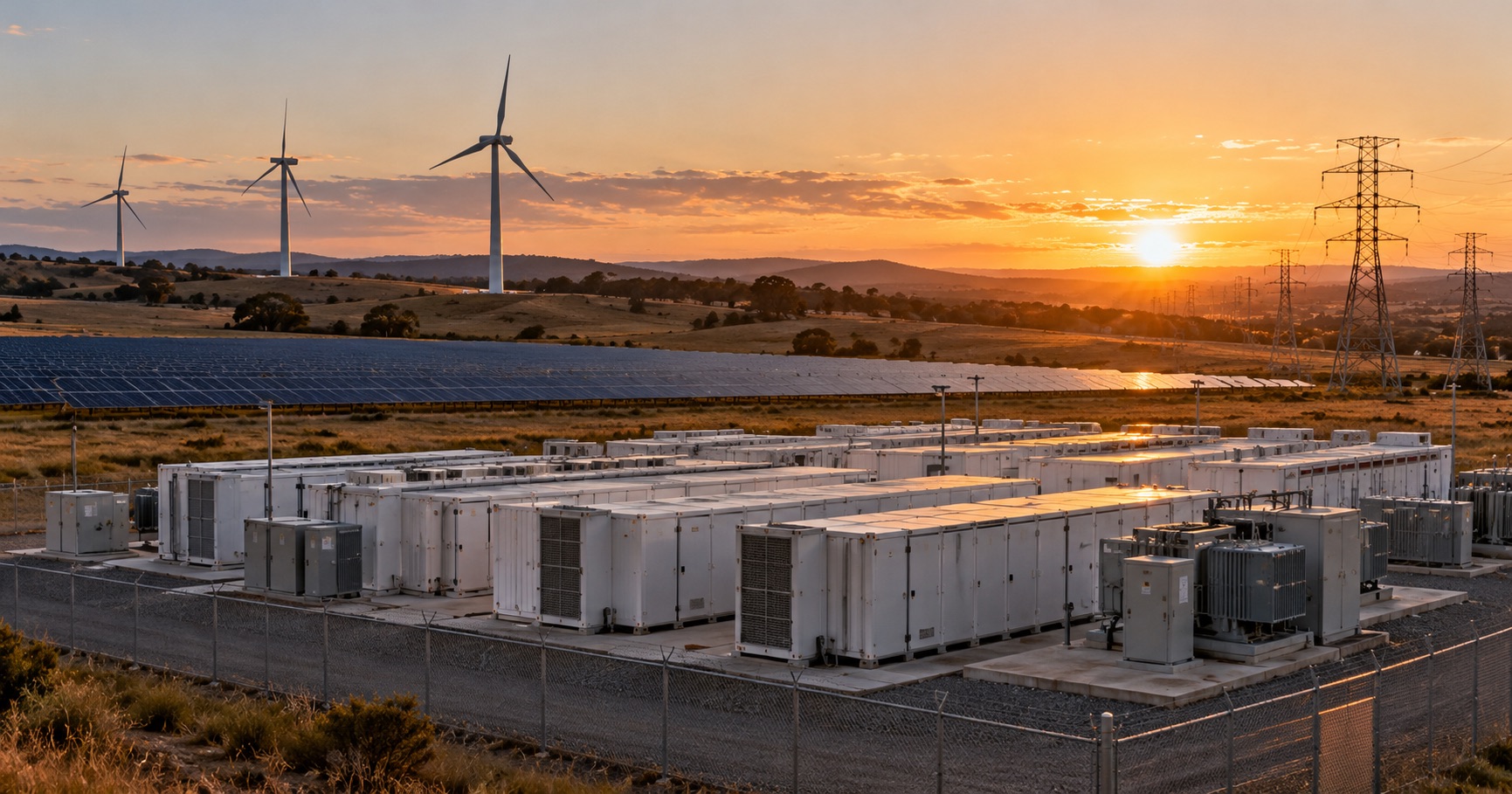
Australia has installed more large-scale batteries than any country other than China and the United States, according to the report. The expansion of battery storage has reduced price volatility and increasingly displaced expensive gas generation during evening demand peaks.
Wholesale electricity costs account for about 40 per cent of household power bills, although changes in spot-market prices do not necessarily flow directly or immediately to consumers.
Australia’s energy regulator announced bill reductions of up to 10 per cent in May across NSW, Queensland and South Australia through its annual Default Market Offer process.
Low prices create investment challenge
The same conditions benefiting electricity buyers could make it harder for developers to justify new renewable projects.
Global Power Energy chief executive Greg Elkins warned that near-term wholesale price reductions could weaken the commercial case for new generation needed to replace ageing coal-fired power stations.
He said increased rooftop solar and renewable generation with no fuel costs were helping push market prices down, but this could create longer-term difficulties if developers cannot secure adequate returns from new projects.
The challenge is particularly significant in NSW and Victoria, where several major wind developments have stalled as lower electricity prices coincide with higher construction costs.
According to Clean Energy Council investment data cited in the report, NSW currently has only one onshore wind farm under construction — Squadron Energy’s Uungula project.
New wind generation is important to NSW plans as Origin Energy’s Eraring coal-fired power station is scheduled to close in 2029. The transition has also been complicated by further delays and higher costs affecting the Snowy 2.0 hydroelectric project.
University of NSW energy systems researcher Dylan McConnell cautioned that lower spot prices may not automatically translate into sustained household savings because electricity retailers also rely heavily on contract and forward-market prices. He said forward prices had increased rather than declined.
The contrast leaves Australia’s electricity market facing two competing pressures: maintaining lower prices for consumers while ensuring developers can finance enough new generation and storage to replace retiring capacity.
SOURCE ATTRIBUTION:
Based on reporting by The Australian Financial Review, published 26 October 2026. Source: www.afr.com