
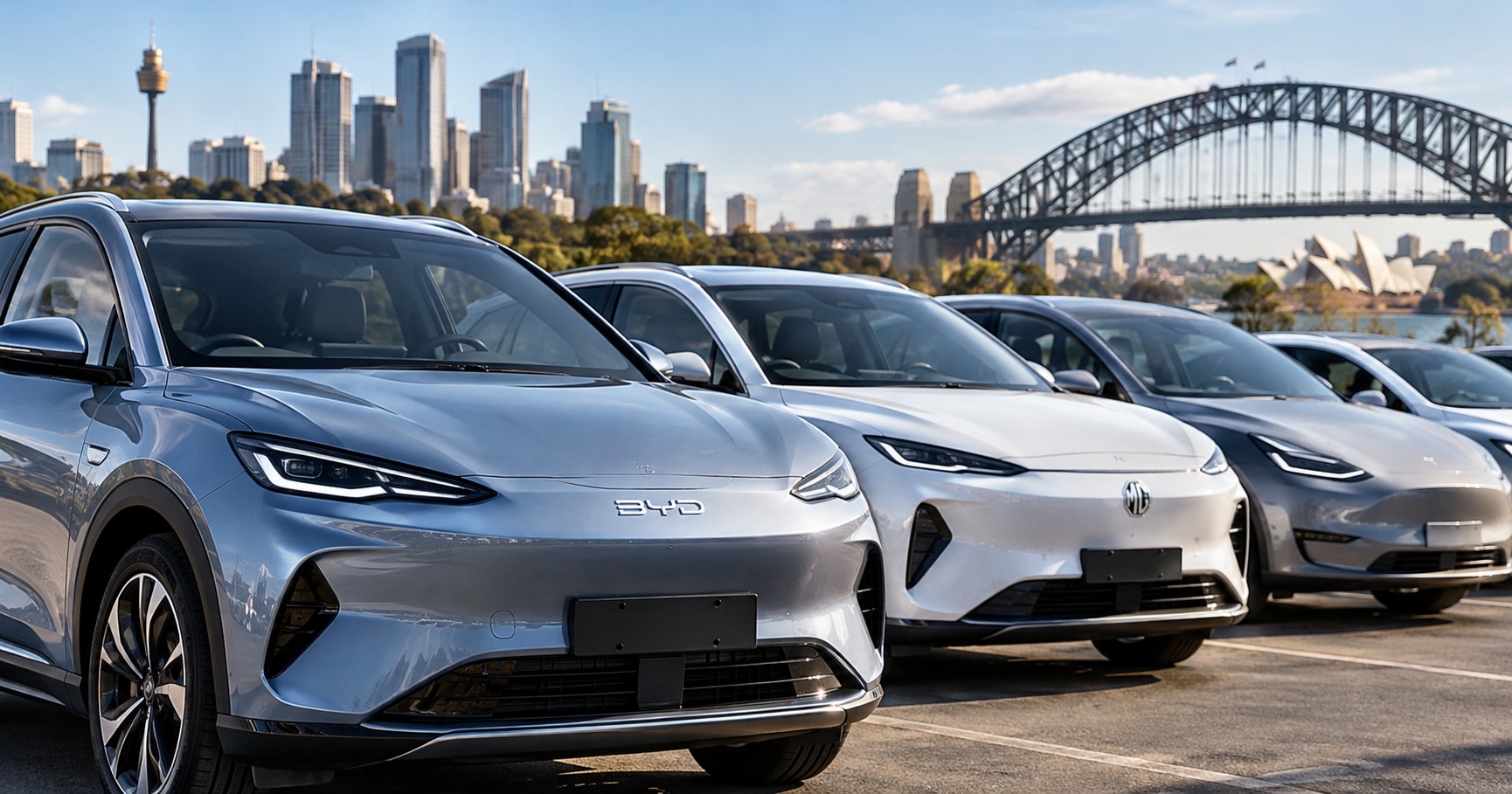
Chinese-made EVs capture 85% of Australia’s electric car sales
Chinese-made electric vehicles have taken a commanding share of Australia’s fast-growing EV market, accounting for about 85 per cent of electric cars sold in 2026, according to figures cited in The Australian Financial Review.
More than 180,000 battery-electric vehicles were sold nationally in the first nine months of the year, up 136 per cent from the same period in 2025. The report linked the increase to higher fuel costs, government tax concessions and a growing supply of lower-priced Chinese models from brands including BYD and MG.
More than half of the EVs sold this year were from Chinese brands, while many vehicles sold by non-Chinese marques were also manufactured in China. Tesla’s Model Y and Model 3, two of Australia’s best-selling EVs, are among the vehicles produced there.
Lower prices reshape competition
Chinese brands now hold 17 of the 20 lowest-priced positions in Australia’s new-car market, according to the report. BYD’s Atto 1, priced at $19,990 drive-away in the accompanying market data, was identified as the cheapest new car available in Australia regardless of fuel type.
Cox Automotive corporate affairs manager Mike Costello said Chinese manufacturers had expanded into export markets and that Australia’s lack of trade barriers had made it an attractive destination.
The price pressure is affecting rival manufacturers. Hyundai said it would not offer its Turkish-made Ioniq 3 electric hatchback in Australia, while Nissan earlier halted plans to sell its next-generation Leaf locally, citing intense competition at the lower-priced end of the market.
Costello said China’s scale in the EV supply chain had given its manufacturers a significant cost advantage, while their vehicles had also improved in technology and design.
Fuel costs and tax settings support demand
The sales surge accelerated after February, when fuel prices rose following US attacks on Iran, according to the report. Higher petrol and diesel costs strengthened the relative appeal of electric vehicles for some buyers.
Government incentives have also played a role. Tax concessions for EVs purchased through novated leases have applied to vehicles costing less than $91,387. The federal government announced changes in May that will lower the eligibility threshold to $75,000, a move the report said is expected to favour lower-priced Chinese models further.
A separate federal policy that applies credits and penalties according to vehicle emissions intensity has also increased the cost advantage of electric vehicles compared with petrol-powered models.
Australia does not impose import duties on Chinese vehicle brands, unlike the United States, which applies a 100 per cent tariff to BYD electric vehicles entering its market.
Cybersecurity concerns remain contested
The rapid expansion of Chinese-made EVs has also prompted political scrutiny.
Opposition cybersecurity spokesman Aaron Violi argued that Chinese manufacturers may pose security risks because of obligations under China’s national intelligence laws, and said the issue should be examined through a federal inquiry. Those concerns remain political claims rather than findings established in the report.
Meanwhile, insurer NRMA said it had recorded an 80 per cent year-on-year increase in requests for EV insurance and expects electric vehicles to account for close to 10 per cent of its total motor policies by 2030.
The figures show that lower vehicle prices, policy incentives and fuel costs are combining to reshape Australia’s electric-car market at a pace that is putting established manufacturers under increasing competitive pressure.
SOURCE ATTRIBUTION:
Based on reporting by The Australian Financial Review, published 10–11 October 2026. Source: www.afr.com