
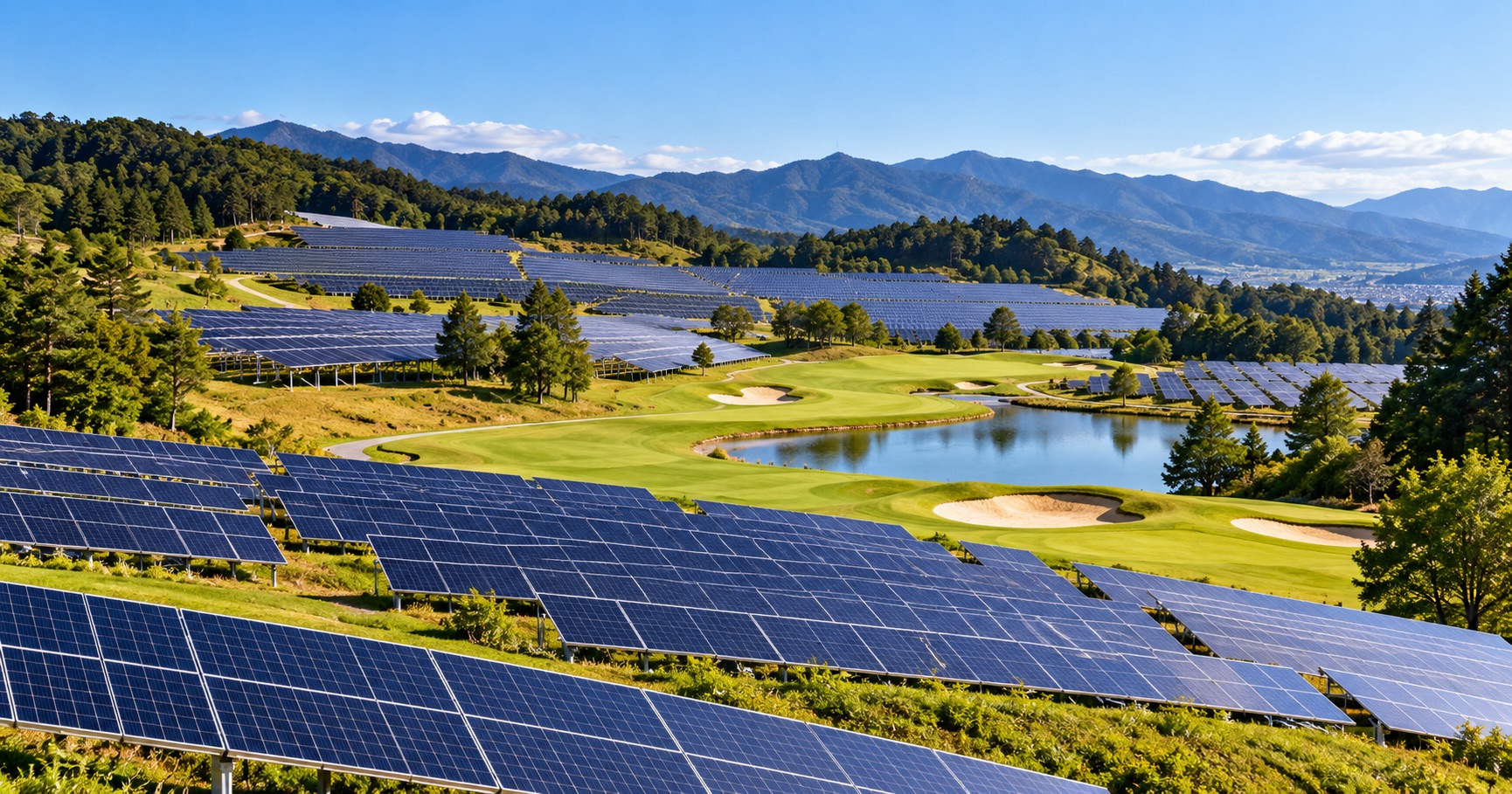
Japan turns ageing golf courses into large-scale solar sites
Japan’s shrinking supply of suitable land is pushing solar developers towards an unconventional source of large-scale project sites: former golf courses.
At Minohara Country Club in Gunma Prefecture, about two hours from central Tokyo, developer Kamisato Kensetsu plans to replace the 27-hole course with a 152MW solar project. The company bought the course in 2025 and intends to keep it operating while approvals and planning are completed, with construction targeted to begin in 2030.
The project reflects a broader trend. BloombergNEF data cited in the report shows about 9 per cent of Japan’s utility-scale solar capacity is located on former golf courses, based on projects of 0.9MW or larger. At least 1GW of solar projects that have been announced or are under construction are also located on golf courses, representing roughly 10 per cent of the country’s current pipeline.
Golf courses offer scarce land for large projects
Japan’s dense population and mountainous geography make it difficult to find large, connected areas with good sunlight, grid access and enough distance from residential communities.
Former golf courses can meet many of those requirements. They often provide broad, relatively flat sites with existing access and less need for major clearing than undeveloped forest areas.
Some of Japan’s largest solar projects have already been developed on former fairways, including the country’s largest such project in Okayama Prefecture in western Honshu. EDP SA has also commissioned a solar development on a defunct 60-hectare golf course in Fukushima Prefecture.
The shift has been helped by the decline of golf in some regional areas. Courses expanded rapidly during Japan’s economic boom around four decades ago, but participation has since weakened, particularly in places facing population decline.
Minohara Country Club illustrates the economics. Despite charging ¥5,000 for unlimited daily play, the club loses more than ¥2 million a year, according to Kamisato Kensetsu representative director Daisuke Toya.
Solar growth faces tighter development conditions
Japan accelerated solar investment after the 2011 Fukushima nuclear disaster led to the closure of the country’s 54 nuclear reactors, which had previously supplied about one-third of its electricity.
The government then introduced a feed-in tariff that guaranteed renewable electricity purchases at prices intended to support project economics. Installations peaked in 2015, after which construction slowed as tariff support was gradually reduced.
The government is now targeting solar generation equal to as much as 29 per cent of electricity supply by 2040, nearly three times the current share, while pursuing net zero a decade later.
Developers are also facing increased community opposition to some large solar developments, including concerns about deforestation, landslides and landscape impacts.
Kyushu University associate professor Andrew Chapman said Japan has substantial technical renewable-energy potential, estimating that all suitable land for solar and wind could generate 14 times the country’s annual electricity consumption. The challenge, he said, is converting that theoretical capacity into projects that can actually be built.
Planning remains lengthy. Environmental assessments and other approvals for projects such as Minohara can take up to four years.
Golf courses will not provide unlimited development opportunities. Renova has shifted towards smaller solar installations on abandoned farmland, but for larger projects, former courses are emerging as one of the remaining land options capable of accommodating utility-scale development.
SOURCE ATTRIBUTION:
Based on reporting by The Australian Financial Review, published 30 September 2026. Source: www.afr.com