
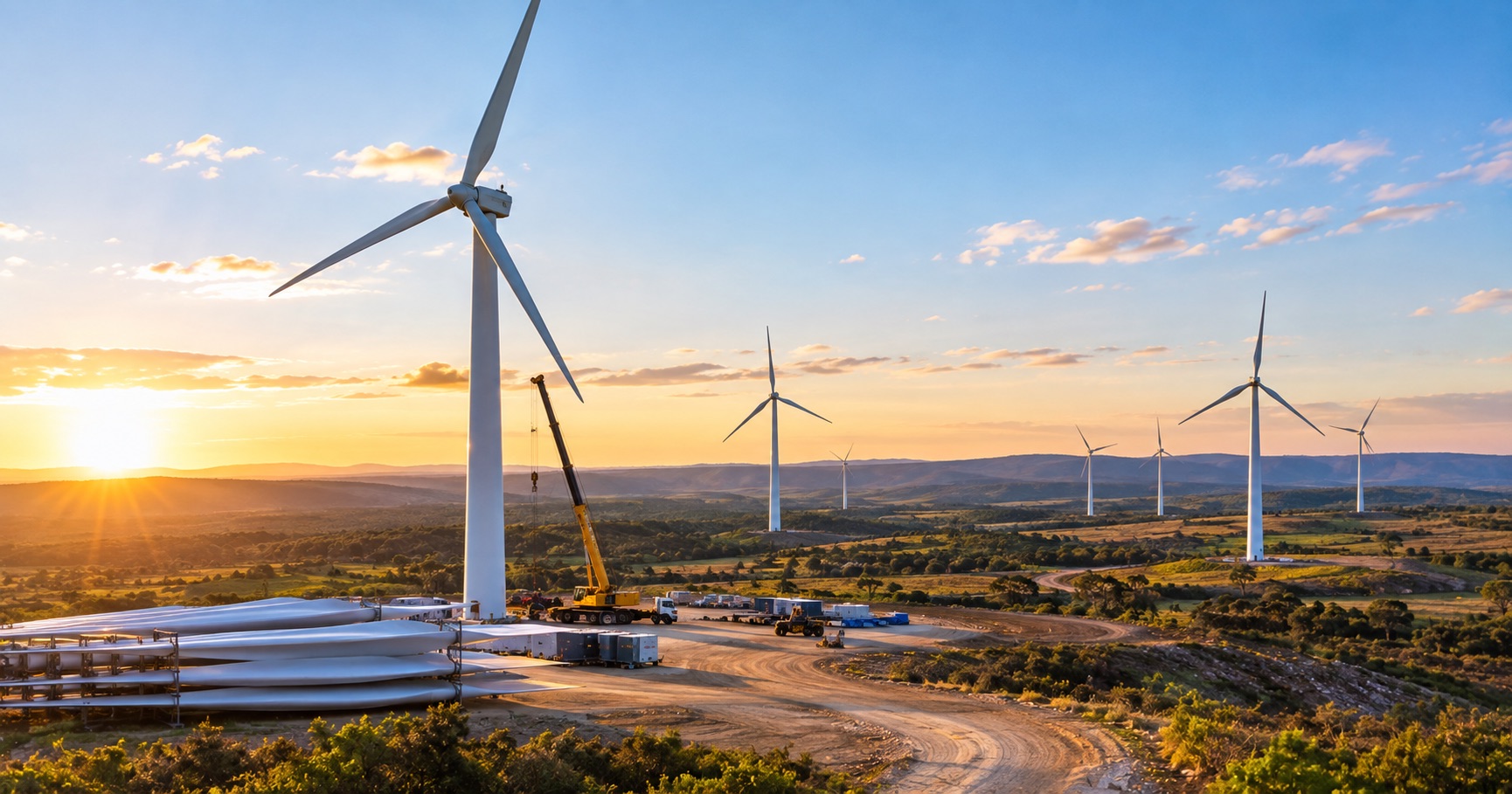
Queensland wind farm secures finance and moves to construction
A major Queensland wind project is set to move into construction after securing $1.7 billion in debt financing, giving momentum to the federal government’s Capacity Investment Scheme after a slow start for large wind developments.
Copenhagen Infrastructure Partners said it had acquired the Gawara Baya wind farm from Windlab and expected construction to begin within weeks. The project is the largest east coast wind farm to reach financial close under the scheme, according to the report.
The financing involves 10 Australian and overseas banks, with individual lenders contributing between $100 million and $250 million. Windlab did not disclose the final construction cost, but typical project financing structures cited in the report indicate the development could cost more than $2.4 billion.
408MW project backed by battery storage and power contracts
Gawara Baya, near Ingham in north Queensland, will have 408MW of wind generation capacity and a 104MW grid-forming battery. The project is expected to produce enough electricity to supply 240,000 homes.
Two power purchase agreements have also been secured. One is with electricity retailer Smartest Energy, owned by Japanese trading company Marubeni, while the other is with Queensland government-owned generator Stanwell.
The contracts provide the project with protection from wholesale electricity market exposure for seven years, with the Stanwell agreement extending beyond that period.
Copenhagen Infrastructure Partners’ Yi-Hua Lu described the project as a significant addition to the company’s Australian portfolio, which also includes the Star of the South offshore wind project.
Capacity Investment Scheme faces pressure to convert projects
The construction commitment comes after a period in which major wind projects supported by the Capacity Investment Scheme struggled to progress to building stage.
The Australian Financial Review reported in March that none of the 15 wind projects then supported by the two-year-old scheme had begun construction. Since then, only a small number of smaller projects had reached that milestone.
Energy Minister Chris Bowen said the Gawara Baya announcement demonstrated that the scheme was helping build a pipeline of investment-ready renewable projects.
Bowen has also changed the scheme’s settings to favour more construction-ready projects, even where support may come at a somewhat higher cost to taxpayers. The scheme is designed to encourage wind, solar and battery investment by providing protection against low electricity prices through competitive support auctions.
Legal challenge resolved before construction
The project also emerged from a legal dispute involving Rainforest Reserves Australia, which challenged the federal environmental approval granted by then-environment minister Tanya Plibersek.
The group argued the approval was inconsistent with environmental laws because of potential impacts on migratory birds. The case was dismissed in June 2025, and Rainforest Reserves Australia was ordered to pay 60 per cent of Windlab’s legal costs, reported at $600,000. The group subsequently entered administration.
The project’s progress is significant for federal renewable energy targets. The government is aiming for renewables to supply 82 per cent of Australia’s electricity grid by 2030 as ageing coal-fired generation retires.
However, recent Clean Energy Regulator data cited in the report showed only limited capacity in the pipeline of projects approaching operation. As of June 2025, 359MW was under assessment, while 400MW was approved in the second quarter of 2026, all from a single Victorian solar farm.
SOURCE ATTRIBUTION:
Based on reporting by The Australian Financial Review.